Marin homeowners can access up to$2,500 per parcelin standard Marin Wildfire Prevention Authority (MWPA) grants, andup to $15,000 per parcel lifetimein the Novato Fire Protection District — but every district funds defensible space differently. With California's Zone 0 ember-resistant rules now in force and Proposition 4 unlocking new state money, 2026 is the year to apply before insurance and resale problems compound. This guide compares all five Marin fire districts, the eligibility rules, and what each program actually pays for.
Why this matters for Marin real estate — not just safety
Wildfire mitigation has quietly become one of the most consequential factors in Marin home values, insurability, and time-to-close. A property that fails defensible space inspection is harder to insure, slower to finance, and more likely to be written into the FAIR Plan at multiples of standard premiums.
For the buyer, that's a closing-table surprise. For the seller, it's a discount the listing agent should have priced in. For the trustee handling an inherited property, it's often the single largest line item between "as-is" and "ready to sell."
The good news: Marin has built one of California's most developed grant ecosystems to push the cost of mitigation off the homeowner. MWPA, individual fire districts, and the Fire Safe Marin nonprofit each fund a slice of the work, and the rules differ by city, ZIP, and sometimes by neighborhood. The numbers below come from the official program pages of each district as of May 2026.
How Marin's grant system works at the foundation: the MWPA
Marin voters approved Measure C in March 2020, creating a 10-year parcel tax that funds the Marin Wildfire Prevention Authority. MWPA pools that money and distributes it through cross-jurisdictional projects (shaded fuel breaks, evacuation route clearance, defensible space inspections) and a direct resident grant program.
The standard MWPA resident grant is up to $2,500 per parcel, awarded as reimbursement after the work is complete. It is integrated with the free Defensible Space and Home Hardening Evaluation that residents request through their local fire agency — you cannot apply for a grant without a current evaluation on file.
Three home-hardening categories are reimbursed at 100% (no homeowner match required), per MWPA's own program documentation:
- Vent replacement with screening 1/8" or finer (the ember-resistant standard)
- Gutter guard installation
- Garage door seal replacement
Most other home-hardening work is reimbursed at 50% — meaning MWPA pays $0.50 for every $1.00 of qualified expense, up to the $2,500 cap. Work must be identified on the resident's official Wildfire Risk Report to be reimbursable.
What about renters and condo owners?
MWPA grants are open to property owners, renters with owner authorization, and authorized representatives — provided the parcel itself has a current evaluation. Condo and townhome owners in HOA-managed buildings should check with their HOA before applying; in some cases the work is the HOA's responsibility, not the unit owner's.
How each Marin fire district compares
The MWPA $2,500 grant is the floor, not the ceiling. Most districts layer additional programs on top. Here's how the five fire jurisdictions in Marin actually compare in 2026:
| District | Resident Grant Cap | Match Rule | Distinctive Feature |
|---|---|---|---|
| Novato Fire | $15,000 lifetime per parcel | 50% on most items; 100% on priority items | Highest cumulative cap in the county; integrated with the Greater Novato Shaded Fuel Break for landscape-scale work |
| Ross Valley | $2,500 (MWPA) + Direct Assistance | 0% for Direct Assistance recipients | Contractor-delivered "Direct Assistance" program for residents physically or financially unable to do the work themselves |
| Sleepy Hollow | $2,500 (MWPA) + $3,000 (local) | 0% on local hazardous-species grant | "Top-off" funding from the Sleepy Hollow Fire Protection District for removing Juniper, Cypress, Arborvitae, Bamboo, and Pampas Grass |
| Mill Valley / Southern Marin | $2,500 (MWPA) | 0% on priority hardening items | Layered Measure U senior exemption on top of Measure C exemption |
| Tiburon | $2,500 (MWPA) + free disposal | N/A on disposal service | Monthly "Chipper Days" at Blackie's Pasture — second Saturday of every month, May through September |
| Central Marin | $2,500 (MWPA) | Per MWPA standard rules | Compliance-led model; grants paired directly with the Central Marin Fire Department's inspection regime |
Novato Fire: the benchmark
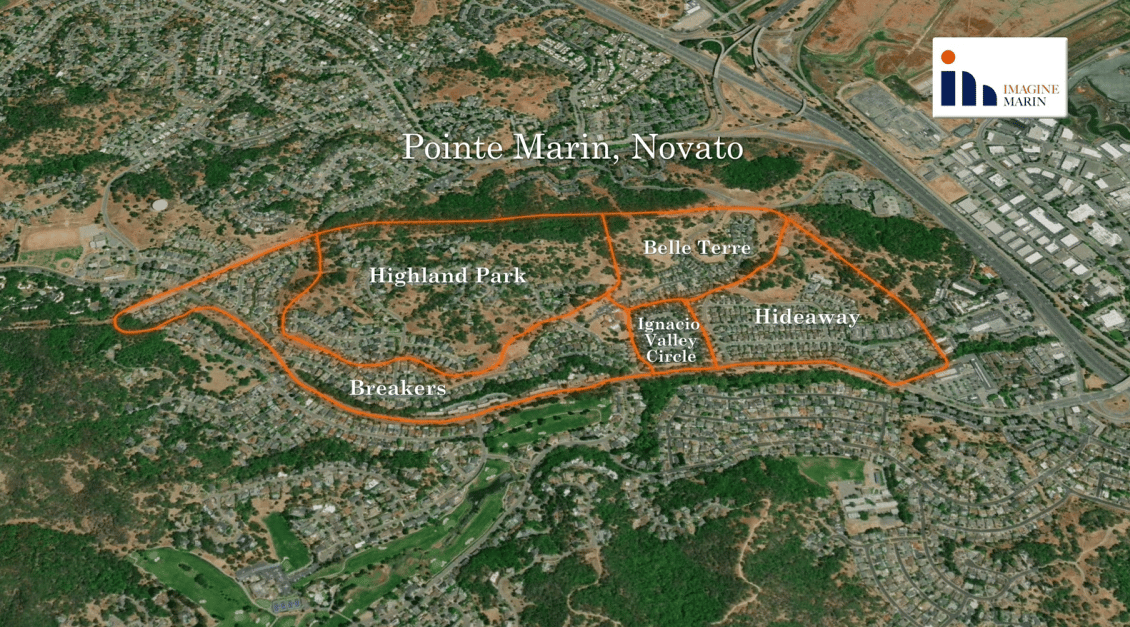
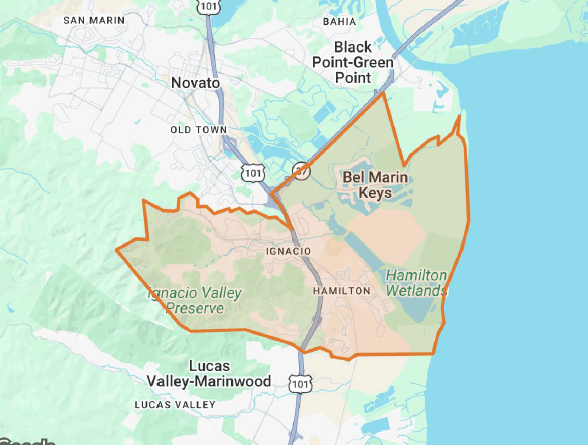
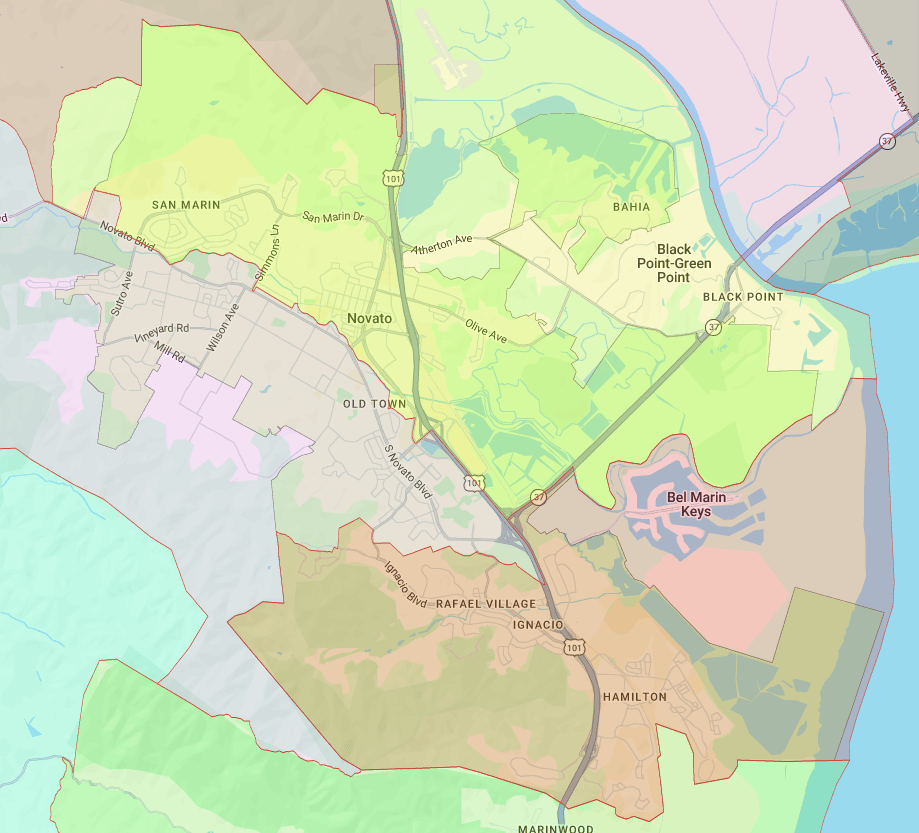
If you own a home in the 94949, 94945, or 94947 ZIPs — Hamilton Field, Pointe Marin, Marin Country Club Estates, Bel Marin Keys, Loma Verde, Rush Creek, or Pacheco Valle — you live in the Novato Fire Protection District, and your cumulative lifetime payout is the highest in Marin.
Per the District's own program guidance, Novato Fire residents can pursue grants in three categories: defensible space vegetation (50% match, up to $1,000), Zone 0 clearing (100% reimbursed, up to $1,000), and home hardening (50% match, up to $2,500 standard or fully reimbursed for priority items). Across multiple grant cycles, a single parcel can claim up to $15,000 cumulative.
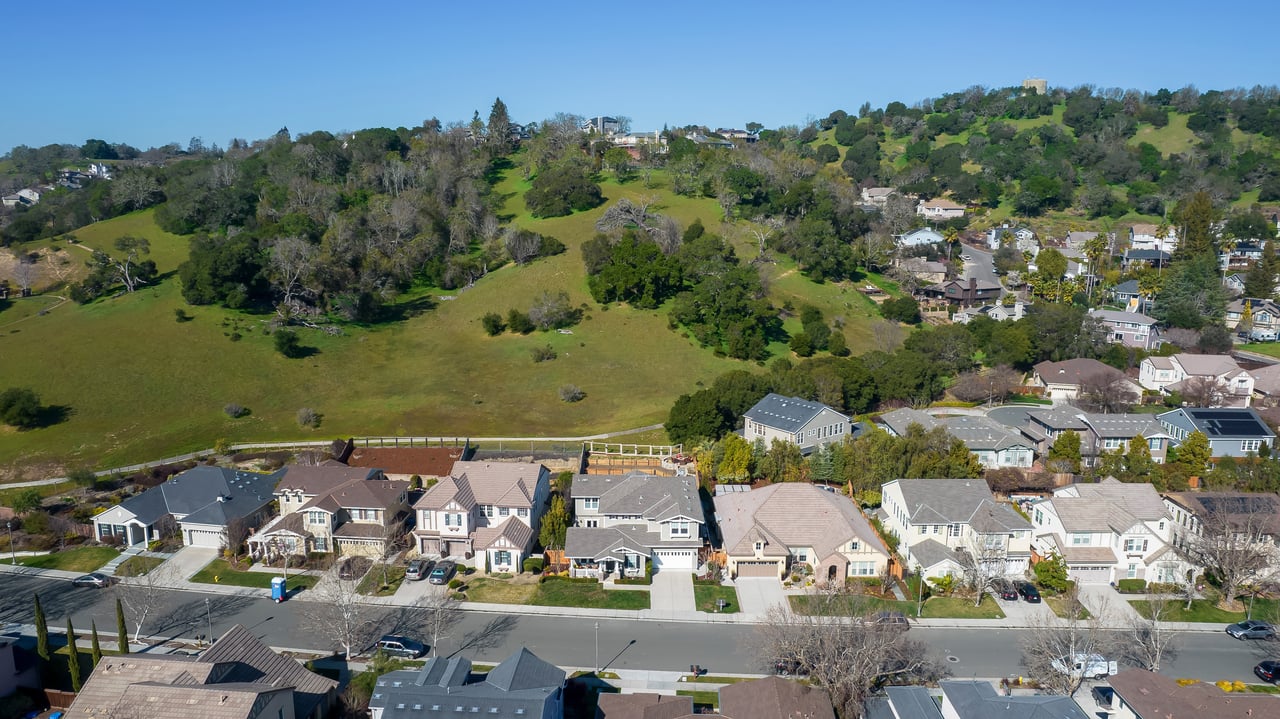
That structure exists because Novato has the largest wildland-urban interface footprint in the county, and the District has historically led on landscape-scale projects like the 200-to-300-foot shaded fuel breaks behind Pacheco Valle, Hamilton Field, and Indian Valley. Owners inside those defined work zones can sometimes get the work done at zero cost through a Right-of-Entry agreement — the District contracts the work directly on private property.
Ross Valley: the most progressive Direct Assistance model
Ross Valley Fire serves Ross, San Anselmo, Fairfax, and Sleepy Hollow. In addition to the standard MWPA $2,500 reimbursement grant, Ross Valley operates a Direct Assistance program for residents who can't physically or financially carry out the work themselves. The fire code official prescribes the work, MWPA funds it, a licensed contractor executes it — the homeowner pays nothing out of pocket.
This solves what I'd call the "liquidity trap" in reimbursement programs: a fixed-income senior may qualify for a $2,500 rebate but doesn't have $2,500 to pay the tree service upfront. The Direct Assistance model pays the contractor directly. Eligibility is determined during the property's defensible space evaluation. (See Ross Valley Fire's grants page for current intake.)
Sleepy Hollow: a $3,000 local top-off
Sleepy Hollow Fire Protection District funds its own Hazardous Vegetation Removal Grant — up to $3,000 per applicant, no homeowner match required — specifically for removing five high-ignition species: Juniper, Cypress, Arborvitae, Bamboo, and Pampas Grass. This stacks on top of MWPA's $2,500 grant for other work, so a Sleepy Hollow homeowner can effectively access $5,500 in a single cycle when both apply.
Sleepy Hollow has also piloted a Zone 0 Direct Assistance project that covers professional consultation, ember-resistant vent installation, and (at reduced cost through a local hardscape partnership) the gravel or stone needed to convert the 0-to-5-foot perimeter to non-combustible material.
Mill Valley and Southern Marin: priority hardening with no homeowner match
The Southern Marin Fire Protection District and Mill Valley Fire administer the MWPA $2,500 grant with a strong tilt toward home hardening over vegetation work. Their interpretation of the MWPA rules emphasizes zero-match reimbursement for the highest-ROI projects:
- Replacing combustible plastic or wood gutters with metal, plus installing metal gutter guards
- Replacing vents with 1/8" mesh ember-resistant alternatives
- Replacing the 5-foot wood fence section where it attaches to the home with non-combustible material
- Removing hazardous vegetation in Zone 0 and Zone 1 (the first 30 feet around the structure)
Southern Marin residents also benefit from Measure U, a local fire tax with its own low-income senior exemption layered on top of the Measure C exemption. The combined effect is real financial relief for a fixed-income senior in Mill Valley.
Tiburon: service delivery over reimbursement
The Tiburon Fire Protection District takes a different approach. Tiburon and Belvedere residents have access to the standard MWPA grants, but the district's signature program is Chipper Days — a free disposal service at Blackie's Pasture overflow lot, held every second Saturday of the month from May through September, 9:00 AM to 4:00 PM. Residents haul vegetation cuttings and slash, indicate the address it came from, and the district handles chipping and removal. The program is funded jointly by the District and the Town of Tiburon Public Works.
This matters in Tiburon because the cost of disposal — not the cost of trimming — is often the limiting factor on large estate parcels. A homeowner can hire a tree crew for half the price if they handle the haul themselves on a Chipper Day Saturday.
The Tiburon Fire Prevention Bureau also offers one-on-one residential home assessments. Their online scheduler books these directly with the district's specialists.
Central Marin: compliance-driven
Central Marin Fire serves Larkspur, Corte Madera, and surrounding areas. The district takes a compliance-led posture: defensible space inspections are rigorous, especially in the Wildland-Urban Interface, and the standard MWPA $2,500 grant is positioned as a tool to help residents meet what the law already requires — not as discretionary money.
Through MWPA funding, Central Marin Fire has also been leading a roadside evacuation route clearance program on approximately 25 miles of streets across Corte Madera, Larkspur, Kentfield, Ross, Fairfax, and San Anselmo. Work that began in August 2025 is clearing 10 feet horizontally and 15 feet vertically of vegetation in the public right-of-way. Property owners remain responsible for ongoing maintenance, but the initial pass is fully funded. (See the Central Marin Fire Roadside Vegetation page for current scope.)
Zone 0 in 2026: why the first five feet are now the most important real estate decision on your property
The single biggest regulatory change shaping 2026 is the rollout of Zone 0 — the ember-resistant zone in the first five feet around every structure. The legislative path runs from AB 3074 (2020) and SB 504 (2024), which directed the California Board of Forestry and Fire Protection to establish the new zone. Governor Newsom's Executive Order N-18-25 required final rulemaking by December 31, 2025; implementation is now phasing in statewide.
Why does Zone 0 outrank Zones 1 and 2 in importance? Because 60 to 90 percent of homes lost in wildland-urban interface fires ignite from embers, not from the main fire front. Embers travel miles ahead of a wildfire and accumulate against the structure itself. Anything combustible within five feet of the wall — wood mulch, woody plants like Juniper, a wood fence touching siding, stacked firewood, a doormat, a wood gate — becomes the wick that brings flame to the building.
For Marin homeowners, three Zone 0 changes are immediately actionable in 2026:
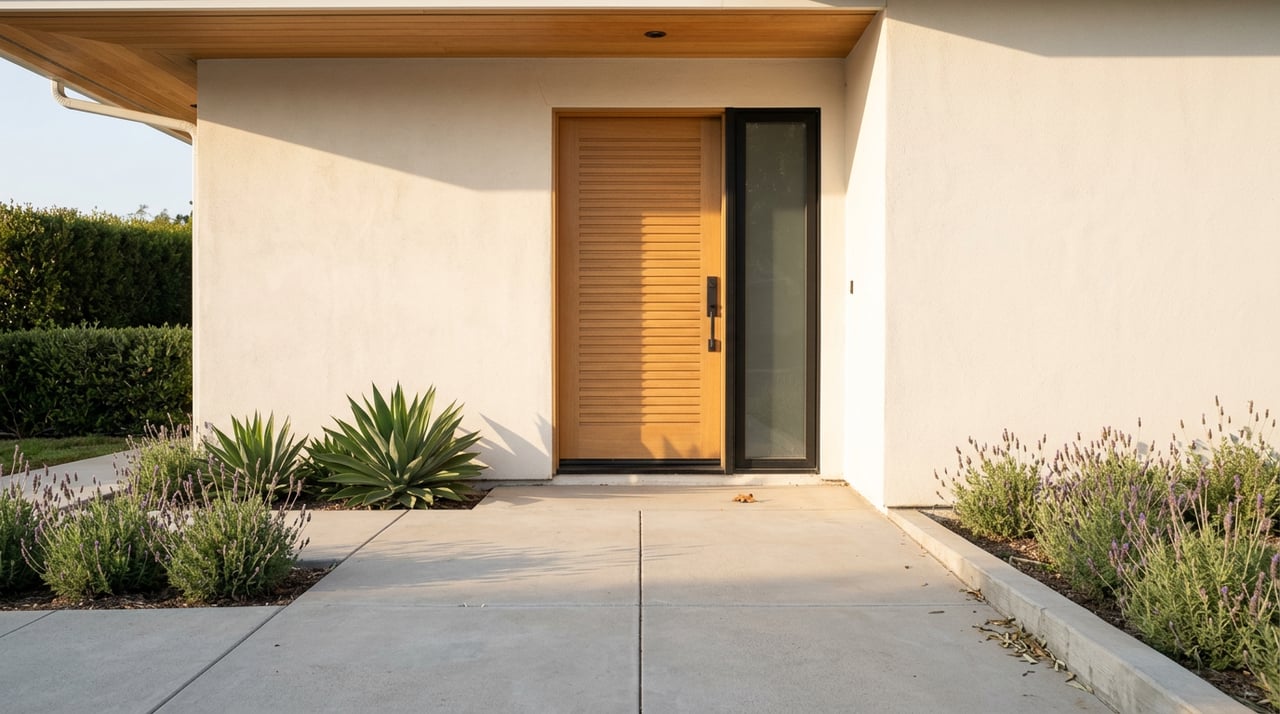
- Replace combustible mulch in the 0-to-5-foot zone with gravel, river rock, or bare mineral soil. Shredded bark and "gorilla hair" mulch are now disqualified from grant reimbursement.
- Replace the first five feet of any wood fence attached to the home with non-combustible material (metal, masonry).
- Remove or relocate high-ignition species like Juniper, Bamboo, and Pampas Grass from the 5-foot perimeter. In Sleepy Hollow, this work is grant-eligible at 100% reimbursement up to $3,000.
Insurance carriers are paying attention. California's home-insurance crisis has pushed many WUI properties into the FAIR Plan — the state's insurer of last resort — at premiums that can run 3x to 5x standard coverage. Several major carriers are now using property-level wildfire risk scoring at underwriting, and Zone 0 compliance is one of the few homeowner-controlled inputs to that score.
What grant money actually pays for — and what it doesn't
Across all five districts, qualifying expenses fall into a defined set of categories. Items have to appear as identified risks on the homeowner's official Wildfire Risk Report.
Generally grant-eligible
- Ember-resistant vent retrofits (1/8" mesh or finer; ASTM-rated products preferred)
- Metal gutters and gutter guards (replacing plastic or wood)
- Garage door seal replacement
- Non-combustible gate or fence section replacement (the 5 feet attached to the structure)
- Removal of dead, dying, or high-ignition vegetation in Zones 0 and 1
- Tree trimming for horizontal and vertical spacing (typically subject to 50% match)
- Roof debris removal and inspection
- Hardscape conversion of the 0-to-5-foot perimeter
Generally not eligible
- Aesthetic landscaping or general property beautification
- Tools and equipment purchases (only materials qualify)
- Cash payments over $500 (must be paid by check, credit card, or traceable electronic payment)
- Work completed before an evaluation was on file
- Items not flagged on the official Wildfire Risk Report
- Work duplicating another grant program (no double-funding)
The low-income senior exemption: real money for fixed-income owners
Both the Measure C MWPA parcel tax and several local fire taxes (including Southern Marin's Measure U) offer low-income senior exemptions. Eligibility hinges on three criteria: the owner is 65 or older as of July 1 of the tax year, the property is owner-occupied as a primary residence, and household income is at or below the HUD Section 8 limits for the San Francisco HUD Metro FMR Area.
Income limits are recalibrated annually by HUD and historically have been higher than many homeowners assume — reflecting the real cost of housing in the Bay Area. For the current year's specific dollar thresholds, check the MWPA low-income senior exemption application page directly; figures are updated each spring and the application must be filed annually before June 30.
This exemption matters in transactions involving an aging-in-place seller or an inherited trust property. If the deceased owner had the exemption on file, that exemption does not transfer to a buyer or successor trustee — the tax goes back on the bill at closing. I see this catch sellers and successor trustees by surprise routinely; it should be priced into the seller's net sheet at listing.
How to apply: the actual five-step process
- Request an evaluation. Novato Fire residents schedule directly with the district's full-time defensible space specialists at novatofire.org or by emailing [email protected]. Central Marin, Ross Valley, and Southern Marin residents are inspected on a roughly biennial cycle by seasonal inspectors; existing reports are accessible at marinwildfire.org/seereport23 with the access code from your inspection notice.
- Review your Wildfire Risk Report. Only items flagged as high-risk or "Required by Law" on your report are grant-eligible. Items recommended as best practice but not flagged generally are not reimbursable.
- Apply through your report. The MWPA grant application is embedded as a link in the digital report — "MWPA grants may be available, click here to start your application." For local programs (Novato's $15K stack, Sleepy Hollow's $3K, Ross Valley's Direct Assistance), apply through the individual district's website.
- Get qualification notice. MWPA reviews complete applications within roughly two weeks. They confirm what work qualifies and at what reimbursement rate before you spend the money. Don't start the work until you've received this confirmation, or you risk doing ineligible work.
- Complete the work and submit for reimbursement. Take "before" and "after" photos. Keep paid invoices and proof of payment (cancelled check, credit card statement, electronic payment record). Submit documentation through the report portal. Reimbursement typically arrives within about one month of complete documentation. Email [email protected] if a payment hasn't arrived within 45 days.
The 2026 fiscal horizon: what Proposition 4 adds
In November 2024, California voters approved Proposition 4, the $10 billion Safe Drinking Water, Wildfire Prevention, Drought Preparedness, and Clean Air Bond Act. Of that, $1.5 billion is dedicated to wildfire and forest resilience, with funding flowing to homeowners primarily through CalFire grant cycles and pass-through programs to local agencies.
Several Prop 4-funded grant programs are actively running in 2026, with deadlines spread across the calendar:
- The California Fire Foundation's Proposition 4 grant program is funding local fire departments and nonprofits in categories including community-scale defensible space and vegetation management. (See cafirefoundation.org for current cycle dates.)
- CalFire's Wildfire Prevention Grants are open in 2026 for hazardous fuels reduction and defensible space education projects.
- A separate CalFire Regional Wildfire and Landscape Resilience Grants program is funding collaborative partnerships for landscape-scale projects.
For Marin homeowners, the practical effect is that the MWPA grant pool is likely to be supplemented rather than replaced. If your local district secures Prop 4 pass-through funding, expect either expanded grant caps or expanded Direct Assistance crews to deliver work to seniors and low-income households who currently can't access reimbursement programs.
What this means if you're buying or selling Marin real estate in 2026
I work most of my transactions in South Novato (94949) and surrounding 94945/94947 neighborhoods, and wildfire mitigation has gone from "nice-to-have disclosure" to a material factor in pricing and timing. Three patterns I see consistently:
If you're a buyer: Order the Wildfire Risk Report during your inspection period — or ask your agent to. The MWPA evaluation is free and the report tells you exactly what mitigation the seller has and hasn't done. If the seller has open Zone 0 issues, that's a credit you can negotiate. If the home is in a sub-tract with active fuel break work funded by Novato Fire, that's a positive you should value.
If you're a seller: Do the MWPA grant work before you list. A property with current defensible space compliance, ember-resistant vents, and a clean Zone 0 is materially more insurable than a comparable property without — and insurability now translates directly to buyer demand. If your home has issues a buyer's insurance carrier won't accept, you're shrinking your buyer pool to cash and FAIR Plan candidates.
If you're a trustee or executor handling an inherited Marin property: factor mitigation costs into your trust sale strategy early. An estate property typically has years of deferred maintenance, and the MWPA grant lifecycle (evaluation → application → work → reimbursement) takes 60 to 120 days. If you're targeting an early summer close, the conversation should start in February. Many of my off-market trust sales close faster precisely because the deferred-maintenance reality is priced in and disclosed up front, rather than fought over after inspections.
Marin Wildfire Grants: Frequently Asked Questions
What is the maximum wildfire grant available to a Marin homeowner in 2026?
The standard MWPA resident grant is up to $2,500 per parcel. Novato Fire residents can stack additional district grants to a lifetime maximum of $15,000 per parcel. Sleepy Hollow residents can layer a separate $3,000 hazardous vegetation grant on top of the MWPA $2,500. Ross Valley residents who qualify for Direct Assistance can receive contractor-delivered work at zero out-of-pocket cost.
Do I have to pay the contractor first and get reimbursed later?
For most MWPA grants, yes — it's a reimbursement program. You pay the contractor, document the work with before-and-after photos and proof of payment, and MWPA reimburses you within roughly a month. Ross Valley's Direct Assistance program is the exception: the district contracts and pays the work directly for eligible residents.
Is Zone 0 already required by law in Marin in 2026?
Yes — California's Board of Forestry and Fire Protection completed Zone 0 rulemaking under Governor Newsom's Executive Order N-18-25 by the end of 2025, and implementation is phasing in statewide. Some Marin jurisdictions are enforcing Zone 0 standards through their existing defensible space inspection program. Even where formal enforcement is still ramping, insurance carriers are increasingly using Zone 0 compliance in underwriting decisions.
What's the difference between Novato Fire's grant and the MWPA grant?
The MWPA grant is a countywide $2,500 program funded by Measure C. Novato Fire's program is a layered local program that incorporates MWPA funds but allows for a much higher lifetime cumulative cap ($15,000 per parcel) and includes integration with landscape-scale projects like the Greater Novato Shaded Fuel Break. Same evaluation requirement, but more total dollars available in Novato.
Can I get reimbursed for work I've already done?
Only if the work was identified as a risk on a current Wildfire Risk Report and the work was completed within the eligible window. You cannot retroactively claim work that predates an evaluation. Save receipts and "after" photos even on work done outside the grant program — in some cases it can be applied retroactively if the documentation is complete.
How does the senior parcel tax exemption work?
If you're 65 or older, occupy the home as your primary residence, and your household income is at or below the HUD Section 8 income limits for the San Francisco Metro area, you can apply annually for an exemption from the Measure C parcel tax. The application must be submitted before June 30 of each year. Southern Marin's Measure U exemption layers on top of the Measure C exemption with slightly higher income thresholds.
Do Marin grants cover home insurance premiums or FAIR Plan costs?
No — grants pay for mitigation work, not insurance. But the mitigation work indirectly addresses insurance: ember-resistant vents, Zone 0 compliance, and current defensible space certification can be the difference between standard market coverage and the FAIR Plan, which often runs 3x to 5x the cost. Doing the grant-funded work is the cheapest path to a better insurance outcome.
Where do I start if I've never had an evaluation?
If you're in the Novato Fire Protection District, schedule an appointment directly at novatofire.org. Everywhere else in Marin, the evaluations happen on a roughly biennial seasonal cycle — check at marinwildfire.org for your district's schedule and to access an existing report by entering your address.
This article is for general informational purposes and is not legal, tax, or insurance advice. Grant programs, dollar caps, eligibility rules, and regulatory requirements change frequently. Verify current details directly with the Marin Wildfire Prevention Authority, your local fire district, or a licensed professional before relying on any specific figure.